What does grade 8.8 mean on a bolt? It means 800 MPa tensile and 640 MPa yield. Learn how 8.8, 10.9 and 12.9 differ—and why galvanized bolts can snap. The first number times 100 gives you the tensile strength; the second number gives you the yield ratio — 0.8 × 800 = 640 MPa. It is the most widely used high-strength grade for general engineering.
We are a fastener manufacturer in Yongnian, Handan — China’s largest fastener production base — making grade 8.8, 10.9 and 12.9 bolts from M5 to M48. In this guide, we explain what the numbers mean, which grade your project actually needs, and one quality trap that most bolt articles never mention.
What Does Grade 8.8 Mean? The Two Numbers, Explained
Grade 8.8 is a property class defined by ISO 898-1, the international standard for carbon and alloy steel fasteners. The two numbers are a simple strength code:
- First number × 100 = minimum tensile strength. For grade 8.8, that is 8 × 100 = 800 MPa.
- Second number × tensile strength = minimum yield strength. For grade 8.8, that is 0.8 × 800 = 640 MPa.
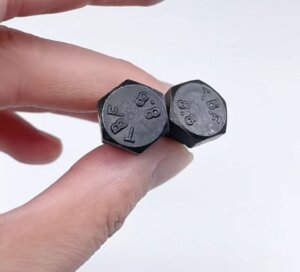
The same math applies to every metric grade. A 10.9 bolt has a tensile strength of 1,000 MPa and a yield strength of 900 MPa. A 12.9 bolt reaches 1,200 MPa and 1,080 MPa. You will normally find these numbers stamped on the bolt head, along with the manufacturer’s mark.
One point buyers often miss: grade only tells you strength. It says nothing about corrosion resistance — that is decided by the material and the coating, which we will cover below.
Grade 8.8 vs 10.9 vs 12.9: Quick Comparison
All three grades are quenched and tempered. The difference is the raw material and the strength it is heat-treated to deliver:
| Grade | Tensile Strength | Yield Strength | Typical Wire Material | Typical Applications |
|---|---|---|---|---|
| 8.8 | 800 MPa | 640 MPa | Medium carbon steel (35K, 45#) | Agricultural machinery, automotive non-critical joints, general connection points |
| 10.9 | 1,000 MPa | 900 MPa | Alloy steel (10B21, 40Cr) | Equipment manufacturing, heavy-load joints in construction machinery |
| 12.9 | 1,200 MPa | 1,080 MPa | Alloy steel (35CrMo, SCM435) | Bridges, wind power, oil and gas pipelines and other extreme-strength applications |
For reference: 35K is the workhorse wire for cold-heading 8.8 bolts, and 45# is the classic medium carbon steel for general 8.8 production.
Which Grade Should You Choose?
The rule is simple: follow the drawing or the design spec. If your project calls for 8.8, order 8.8. Here is the quick logic our engineers use:
- Choose 8.8 when the joint carries normal loads — most agricultural machinery, general equipment and automotive non-critical positions. It is the most cost-effective high-strength grade.
- Choose 10.9 when the connection is under heavy or cyclic load — equipment frames, construction machinery, structural joints.
- Choose 12.9 only where the design demands extreme strength — bridge, wind power and oil pipeline applications, or compact joints with very high preload.
Do not “upgrade” on instinct. A higher grade is not automatically safer: as strength rises, the bolt becomes harder and less ductile, more sensitive to notch effects and hydrogen embrittlement. And the nut, washer and parent thread must match the bolt class — replacing 8.8 with 12.9 in a joint designed for 8.8 can simply move the failure somewhere else.
Why Do Galvanized Grade 8.8 Bolts Break? Read This Before You Blame the Material
This is one of the most common complaints we hear from buyers: “The grade 8.8 galvanized bolts snapped — is the steel substandard?” Nine times out of ten, the material is fine. The real cause is hydrogen embrittlement.
Here is what happens. Before electroplating, bolts are pickled in acid. During that acid pickling and plating process, hydrogen atoms diffuse into the steel. In high-strength steel, that trapped hydrogen can cause cracks to develop slowly under stress — the bolt passes a tension test today and fractures weeks later, with no visible warning.
That is why the industry rule exists: fasteners of grade 8.8 and above with hardness over 320 HV must be baked (de-embrittled) after zinc plating to drive the hydrogen out. The problem is that baking costs time and money. Some suppliers skip it to cut costs — and their bolts look identical to properly treated ones right up until they fail.
How to protect yourself as a buyer:
- Ask the supplier directly: “Do you bake your plated high-strength bolts?” A serious factory will answer without hesitation.
- For high-strength bolts that need corrosion protection, consider hot-dip galvanizing or Dacromet coating, which avoids the hydrogen embrittlement risk of electroplating.
- Watch failure timing. A bolt that breaks during installation is usually a strength problem. A bolt that breaks days or weeks later points to hydrogen embrittlement.
Grade 8.8 vs Stainless Steel: Two Different Questions
Buyers often ask: “Should I use 8.8 or stainless?” That question mixes two things. Grade 8.8 is a strength class for carbon steel. Stainless steel bolts use a different marking system — A2-70 means 304 stainless with 700 MPa tensile strength, roughly comparable to 8.8 in strength, but with far better corrosion resistance.
So the real question is: does your application need corrosion resistance? If it is a dry, indoor or regularly maintained connection, carbon steel 8.8 with zinc plating is usually the economical choice. In marine, chemical or permanently wet environments, stainless wins — at a price. As a rule of thumb from our production cost: 304 stainless is roughly 3× the price of carbon steel, and 316 is around 6×.
We compare the two in detail in Carbon Steel vs Stainless Steel Bolts: Which One Should You Buy?
FAQ
Is grade 8.8 the same as SAE Grade 5?
Close, but not identical. SAE Grade 5 (≈827 MPa tensile) is the nearest imperial equivalent of 8.8 (800 MPa), but they belong to different standard systems with different threads and testing requirements. Do not substitute one for the other without checking the drawing.
What material is a grade 8.8 bolt made of?
Medium carbon steel, most commonly 35K or 45# wire, quenched and tempered to reach 800 MPa tensile strength. 35K is the standard choice for cold-heading production.
Can I use 12.9 instead of 8.8?
Not recommended unless the joint is designed for it. Higher strength means lower ductility and higher hydrogen embrittlement sensitivity, and the mating nut and thread must match the class. Replace like-for-like.
Need grade 8.8, 10.9 or 12.9 bolts? Boen Fastener manufactures hex bolts from M5 to M48 per DIN 933, DIN 931, DIN 912 and ISO 7380, with black oxide, zinc, hot-dip galvanized and Dacromet finishes. Standard sizes are in stock and custom production takes about 15 days. Contact us for a quote.
Pingback: Black Oxide vs Zinc Plating Bolts - BOEN FASTENER