Black oxide vs zinc plating — which finish is right for your bolts? The short answer: zinc plating protects against corrosion far better, while black oxide costs less and leaves thread dimensions untouched. If your bolts will face moisture, choose zinc plating. If they live in a dry indoor assembly and you want the lowest cost with zero dimensional change, black oxide is the right call.
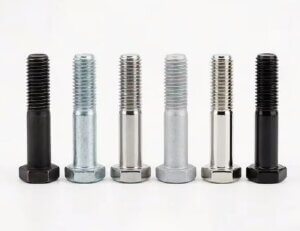
We are a fastener manufacturer in Yongnian, Handan — China’s largest fastener production base — supplying black oxide, zinc plated, hot-dip galvanized and Dacromet-coated bolts from M5 to M48 to customers across Southeast Asia, Central Asia and South Africa. In this guide, we compare these finishes using real factory numbers: salt spray hours, cost differences, and one hydrogen embrittlement trap that affects high-strength bolts.
What Is Black Oxide?
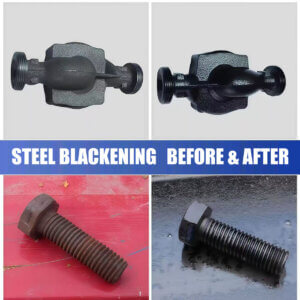
Black oxide (also called blackening) is a conversion coating, not a deposited layer. The heat-treated bolt is soaked in a hot alkaline oil bath, where a thin magnetite (Fe₃O₄) film forms on the surface of the steel itself. The result is a uniform matte black finish with no added thickness — thread tolerances stay exactly as manufactured.
The trade-off is corrosion resistance. The oxide film on its own has almost none: a black oxide bolt relies on the oil film it soaks in after treatment. In a dry indoor environment it will last for years. Expose it to humidity or rain, and red rust can appear within days.
What Is Zinc Plating?
Zinc plating (electro-galvanizing) deposits a thin layer of zinc onto the bolt by electrolysis. Because zinc is more reactive than steel, it corrodes first — this “sacrificial” protection keeps working even when the coating gets scratched.
A standard electro-zinc plated bolt passes 48–96 hours of salt spray test (ASTM B117) before red rust appears. That covers most indoor applications and light humidity, but not outdoor, coastal or high-salt environments.
One confusion worth clearing up, because it costs buyers money every year: black zinc is not black oxide. Black zinc is zinc plating followed by a black passivation treatment — it delivers the corrosion performance of zinc with a black appearance. If a drawing simply says “black bolt”, always confirm which process is required. The two finishes look similar but differ completely in corrosion life and price.
Black Oxide vs Zinc Plating: Side-by-Side
| Property | Black Oxide | Zinc Plating |
|---|---|---|
| Appearance | Matte black | Bright silver or yellowish |
| How it protects | Oil film only | Sacrificial zinc layer |
| Salt spray life | Under ~24 h (with oil) | 48–96 h standard |
| Coating thickness | None — conversion layer | 5–25 µm deposited zinc |
| Thread fit | Unchanged | Slight buildup possible |
| Hydrogen embrittlement | No risk | Yes — baking required for grade 8.8+ |
| Relative cost | Lowest | Low to moderate |
| Best for | Dry indoor, precision assembly | Indoor with occasional moisture |
When Zinc Plating Is Not Enough: Hot-Dip Galvanizing and Dacromet
For harsh environments, the finish ladder goes two steps higher:
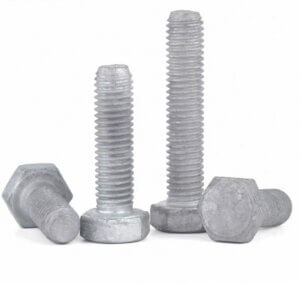
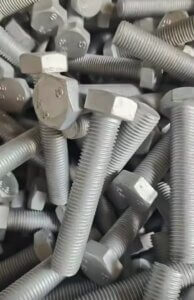
- Hot-dip galvanizing. A much thicker zinc layer applied by dipping. Salt spray life is typically specified at no less than 480 hours, and demanding applications — coastal construction, wind power — commonly require 720 to 1,000 hours before red rust. It is the go-to finish for large parts and structural work.
- Dacromet (zinc flake coating). 800–1,200 hours of salt spray resistance, at roughly 3–5 times the price of zinc plating. It is best suited to small precision fasteners.
There is one more reason high-strength bolt buyers specify Dacromet: the process involves no electroplating acid bath, so there is no hydrogen embrittlement risk. Zinc-plated grade 8.8 and above must be baked after plating to drive out absorbed hydrogen — if a supplier skips that step to save cost, the bolts can snap days or weeks after installation. We explain this failure mode in detail in our guide to bolt grades (8.8 vs 10.9 vs 12.9).
Why Two “Zinc Plated” Quotes Can Have Different Prices
Here is a factory insight most articles never mention: salt spray requirements are customized per order. The same M12 zinc-plated bolt is priced differently depending on whether the buyer requires 48, 72 or 96 hours of salt spray protection — and the same logic applies to hot-dip galvanizing, where zinc layer thickness and part size also move the price.
So when you compare two quotes that both say “zinc plated”, check the required salt spray hours behind each one. A lower price may simply mean a shorter test was quoted.
Which Finish Should You Choose?
- Dry indoor assembly, tight tolerances, lowest cost → black oxide
- Indoor use with occasional moisture → zinc plating (48–96 h)
- Outdoor, construction, large parts → hot-dip galvanizing (480 h and up)
- Coastal, wind power, high-strength small fasteners → Dacromet (800–1,200 h, no hydrogen embrittlement)
And if you are still deciding at the material level — carbon steel or stainless — read our comparison of carbon steel vs stainless steel bolts first, because the finish question only applies to carbon steel.
FAQ
Is black oxide rust-proof?
No. Black oxide itself provides almost no corrosion protection — it depends on an oil film. Use it only in dry indoor environments.
Can grade 8.8 bolts be zinc plated?
Yes, but they must be baked after plating to prevent hydrogen embrittlement. Always ask your supplier: “Do you bake after plating?” If they hesitate, walk away.
Is black zinc the same as black oxide?
No. Black zinc is zinc plating with a black passivation — it protects like zinc. Black oxide is a chemical conversion finish that barely protects at all. They look similar but perform very differently.
Which finish is cheapest?
Black oxide is the cheapest, followed by zinc plating, then hot-dip galvanizing, with Dacromet at roughly 3–5 times the price of zinc plating.
Choosing the right finish is really about knowing your bolt’s environment. Tell us where your bolts will be used, and we will recommend the most cost-effective finish — with salt spray test reports available on request. Contact us on WhatsApp at +86 132 9307 0568 or by email.