Carbon steel vs stainless steel bolts — which one should you buy? The short answer: choose carbon steel when your budget is limited and the bolts will work in a dry, indoor environment. Choose stainless steel when the bolts are exposed to moisture — especially in marine environments. As a fastener manufacturer in Yongnian, Handan — China’s largest fastener production hub — we produce both materials every day, and this guide explains the real differences in strength, corrosion resistance, and cost, so you can order the right bolts without overpaying.
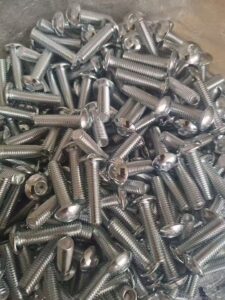
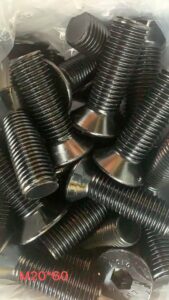
Carbon Steel Bolts
Carbon steel is the default material for most bolts sold worldwide. It is strong, easy to machine, and inexpensive.
Most carbon steel bolts come in Grade 8.8, 10.9 or 12.9. But bare carbon steel rusts in humid air, so outdoor applications always need a protective coating. At our factory we produce carbon steel bolts from M5 to M48 in Grade 8.8, 10.9 and 12.9, manufactured to DIN 912, DIN 933, DIN 7991 and ISO 7380 standards. Available surface treatments include black oxide, electro-galvanized zinc, hot-dip galvanizing and Dacromet.
The trade-off is simple: carbon steel gives you the highest strength per dollar, but you must protect it from corrosion. In our experience, a hot-dip galvanized Grade 8.8 bolt covers most general construction needs at a fraction of the stainless price. Regular sizes are in stock, and custom production takes about 15 days.
Stainless Steel Bolts: 304 vs 316
Stainless steel contains at least 10.5% chromium, which forms a thin passive layer that prevents rust — no coating needed.
Two grades dominate the market:
- 304 (A2) — the general-purpose grade. Handles moisture and mild chemicals. Common in food processing and general outdoor equipment.
- 316 (A4) — adds molybdenum, which greatly improves resistance to salt water and chlorides. The standard choice for marine and coastal environments.
Be careful with strength: common stainless bolts (A2-70, A4-70) reach only about 700 MPa — far below Grade 12.9 carbon steel. Never use stainless steel to replace high-grade carbon steel in load-bearing joints.
Price is the other difference. Based on our current quotations, 304 stainless bolts cost about 3× the price of carbon steel, and 316 about 6×. If your environment does not truly require 316, that premium buys you nothing.
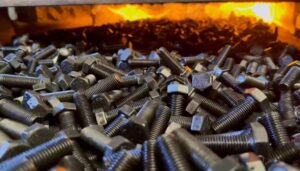
Carbon Steel vs Stainless Steel Bolts: Comparison
| Property | Carbon Steel Bolts | Stainless Steel Bolts (304 / 316) |
|---|---|---|
| Corrosion resistance | Poor without coating — needs black oxide, zinc, hot-dip galvanizing or Dacromet | Excellent — 316 is the standard choice for marine and chemical environments |
| Tensile strength | Up to 800–1,200 MPa (Grade 8.8 / 10.9 / 12.9) | Around 700 MPa (A2-70 / A4-70) — not for high-load joints |
| Relative cost | Baseline | 304 ≈ 3× carbon steel; 316 ≈ 6× |
| Magnetic | Yes | 304 slightly magnetic after cold working; 316 almost non-magnetic |
| Best for | Structural steel, indoor machinery, automotive, dry environments | Marine, coastal, chemical plants, food processing, outdoor use |
Which Should You Choose?
Choose carbon steel when the bolts work in a dry or indoor environment, when the joint carries heavy loads, or when budget matters most. Grade 8.8 with hot-dip galvanizing covers most structural and machinery applications.
Choose stainless steel when the joint is exposed to water, salt or chemicals — especially in coastal areas — and when replacing the bolt later would be difficult or expensive.
Rule of thumb from our factory floor: if the joint gets wet, use stainless steel. If it carries load in a dry place, use carbon steel.
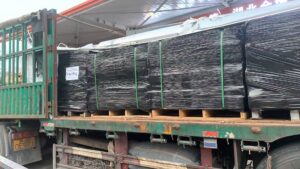
Many of our customers in Southeast Asia, Central Asia and South Africa order both materials in one shipment: carbon steel for structural parts, stainless steel for exposed connections. This combination controls cost and avoids rust problems at the same time.
Frequently Asked Questions
Can I mix carbon steel and stainless steel bolts in the same assembly?
No. When the two metals touch in wet conditions, galvanic corrosion makes the carbon steel side rust much faster. The safe approach is one material per joint.
Is stainless steel stronger than carbon steel?
No. High-grade carbon steel (8.8, 10.9, 12.9) is much stronger. Stainless steel trades strength for corrosion resistance.
Why is stainless steel so much more expensive?
Nickel and chromium make the raw material costlier, and stainless steel is slower to machine. In our quotes, 304 runs about 3× carbon steel, and 316 about 6×.
Still Not Sure?
Send us your drawing or requirement — we quote both carbon steel and stainless steel options, so you can compare side by side before you order.